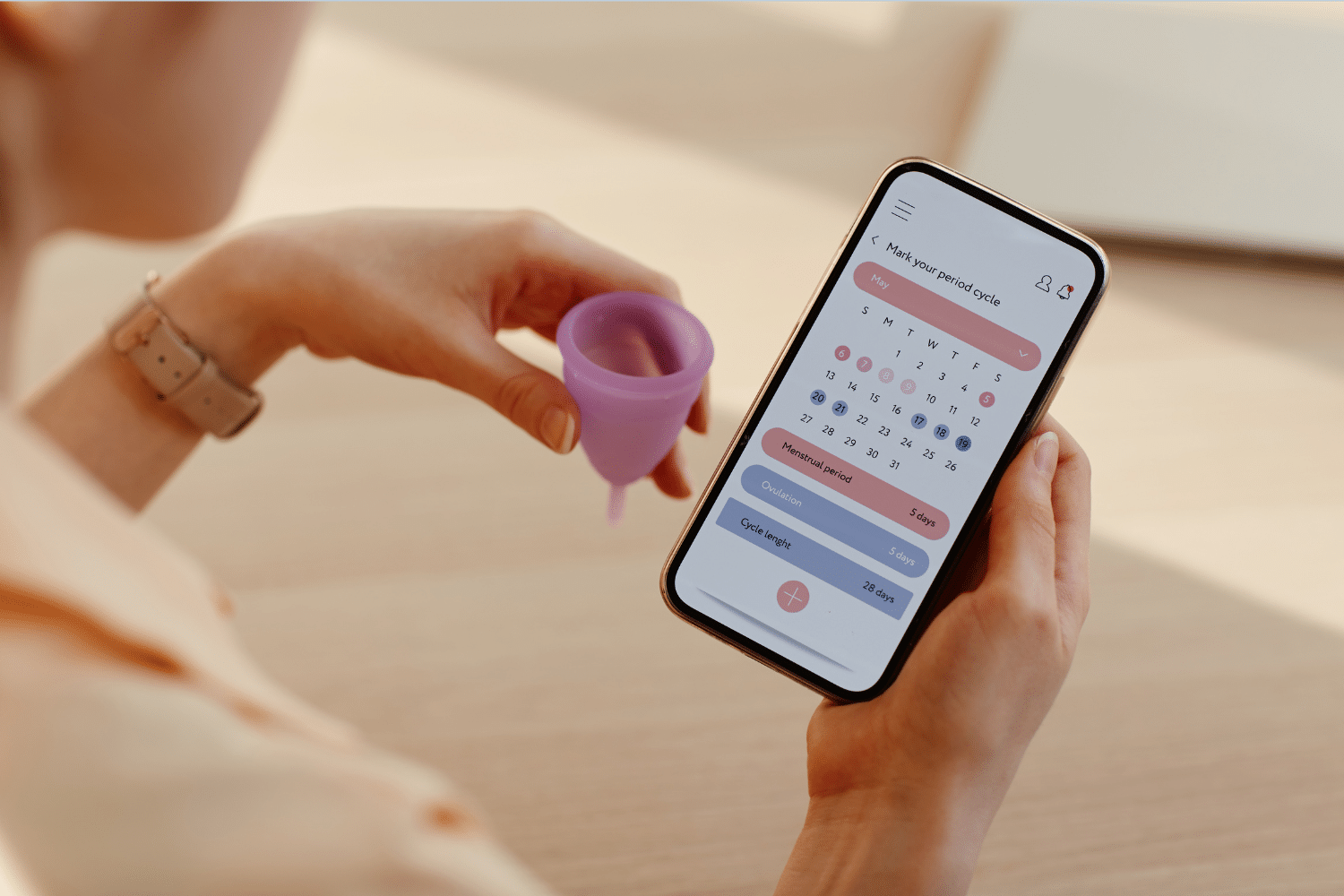
Tracking your menstrual cycle is the observation of what happens during one cycle, period to period. Get to know your moods, hormones, symptoms, and log it in an app or a cycle journal to be able to predict or anticipate what’s coming.
Tracking Your Cycle, Period to Period
Your fertility is a marker of health, Dr Nathalie Crawford says. If you have a functioning reproductive system, and everything works “correctly” or as intended, you can conclude that you are pretty healthy.
Your reproductive system is a very intricate system of hormones that controls the possibility to create life, every single month. If lifestyle factors or health conditions negatively hinder these hormones, your fertility will be impacted.
That is why it is so important, whether you’re trying to conceive or not by the way, to track your cycle. If you notice that there are irregularities in your cycle, it can be an alarm bell for something. And the day you want to conceive, you might have been able to do something about it.
Of course, if you are trying to conceive, you are only fertile during max six days within one cycle. Tracking your cycle or finding your fertility window will definitely help.
The main thing to observe is the regularity of it: does your period always occur every X days, cycle in, cycle out? It should come back regularly, with a 3-5 day margin. So if it occurs every 31 days without fault, great. If one cycle it’s 27 days, another it’s 35, that’s too much of a fluctuation. You probably need to write it down, make notes somewhere. Unless you have a fantastic memory, it’s easy to forget one “month” to the next.
More on tools you can use to actively track in a few paragraphs.
More on the importance of a healthy cycle soon.
Observing Symptoms
Aside from knowing when you get your period, there are symptoms that you can identify all throughout your cycle. They can be super useful to track, or notice at least. I realised when I started tracking my cycle that suddenly, I knew what was happening to me, in my own body, for the first time in my reproductive years. And it was at the same time roughly, every cycle.
Symptoms that you can observe:
- Your moods: I never thought I was a moody person, but suddenly I could understand why I was getting frustrated leading to my period. Or why I was super enthusiastic once my period had finished. I talk about moods and training in here: Understand Your Cycle and Improve your Life .
- Your body temperature: it’s the one that blows my mind every month. Once you have ovulated, your progesterone starts being released. In the process, without fail, your temperature rises. Obviously you need to be measuring your temperature every day to notice. I started doing that after I stopped hormonal birth control. It took a while for my cycle to become regular, but once it had, I could see clearly the change in temperature pre- and post-ovulation.
- Your cervical mucus: what looks like vaginal discharge around ovulation time, is your cervical mucus making it easy for sperm to come through. The egg-white looking mucus is your oestrogen loosening the way for sperm to reach the egg. That only happens when you are ovulating.
- Your cervix: now, not everyone wants to go and feel their cervix manually. But that “bridge” between your vagina and your uterus, moves position during your cycle. Early and late cycle, it is quite high, so it’s not easy to feel it. During ovulation, your cervix comes lower in your vagina, to facilitate sperm to come up and reach the egg. If you can feel the difference with your fingers, you’ll know ovulation is happening.
Identify the Different Phases of Your Cycle
I believe every woman should learn what happens during her cycle, it feels so empowering. Knowing what happens when, especially when you’re a complicated hormonal machine, is the road to understanding yourself. It’s a way to help you align your calendar or your expectations of yourself with what’s actually taking place.
That’s why tracking your cycle should be an essential part of your routine, even if you’re not trying to conceive. Sometime especially if you’re not trying to conceive, and are going natural on the contraception front. You need to know when not to have intercourse !
I started using an app called Natural Cycle to take control of my contraception naturally. It’s the only FDA-approved natural contraception app there is for now. It’s an app to track your cycle, period, ovulation, symptoms, etc. I know where I am in my cycle at any given moment, and I can predict when I will be fertile or not. I also tracked my pregnancy on it.
There are lots of apps that you can use. What matters is that you find something that works for you. Ask friends, your sister, how they track their cycle, people you trust. Sometimes it will be just a calendar app, and that’s fine.
What I like about mine is that I could predict, based on previous cycles, and symptoms, when my fertile window was going to be.
You can use an Oura ring to observe symptoms, and lots of other wearable devices. If you know roughly when you’re going to ovulate, there are ovulation strips that you can pee on to confirm. There are also LH strips to identify an LH surge – meaning ovulation is coming. Use the tools that are available to know which hormones are rising and when.
Some women like to keep a journal of symptoms and feelings, moods. Maybe that’s for you too?
Tracking Your Cycle for Optimal Health
An optimal reproductive system is a marker of health, and can give you indications of what is happening in your body. You can use the knowledge to adapt your sports classes (based on your energy levels), your nutrition (how to support hormones at which moment of your cycle), a girl’s trip, a couple’s trip, a night in staying cosy when you now your period is coming.
Getting to know your cycle is one of the most empowering things you can do. I’d love to know when you started or if you’re still on the fence.
Essential Hormones to Know About When You’re TTC
The Road to Motherhood Can be a Bit**
How Chronic Inflammation Impacts Your Fertility
