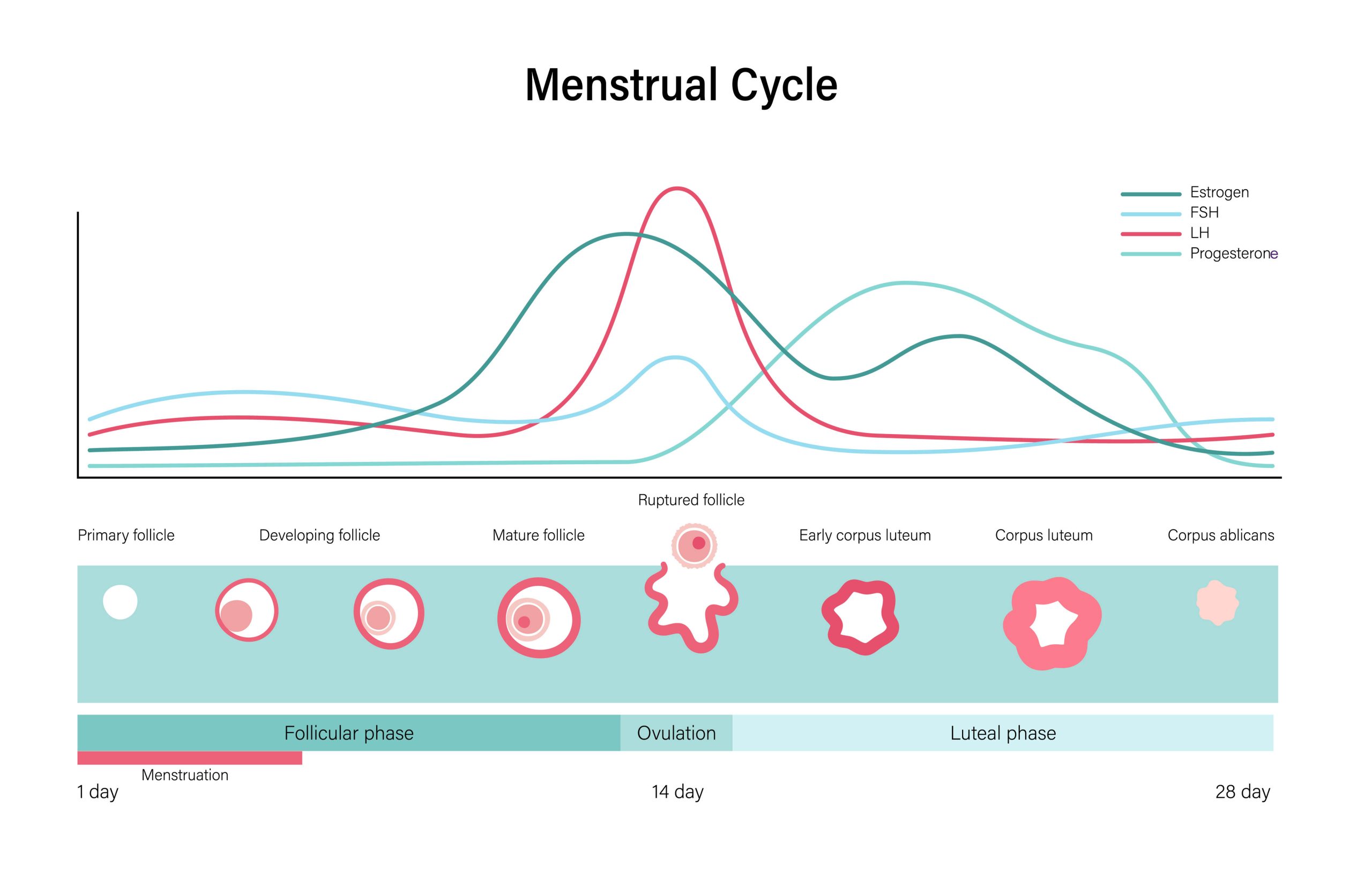
As women, our female hormones are literally the instructions on how our body should function. If one is missing, or not produced / released as planned, it derails how the machine is supposed to work. When you’re trying to conceive (TTC), hormones play a very important part, so let’s see how the orchestra plays.
Oestrogen : the Building Block of Female Hormones
Oestrogen is an essential part of the feminine cycle as it leads to ovulation, which is what we’re interested in here. There are multiple types of oestrogen, responsible for various functions in your uterus (whether during menstruation, pregnancy or menopause).
During menstruation, oestrogen slowly rises from roughly day 6 – after your period – up until ovulation. Ovulation might occur on day 14, but like most women, it might not. Only 15% of the menstruating population has a 28-day cycle. My ovulation for example is usually closer to days 18-21. Here are ways to find out when you ovulate.
Each cycle, you have hundreds of eggs who want to get ready, mature and eject their egg. But only one lucky winner gets to do it (two, and you get twins).
One of oestrogen’s jobs is to help the mature egg (out of the hundreds that are getting ready) come out of its follicle. Once the follicle ruptures and lets the egg out, it wanders down the fallopian tube; it’s ready to be fertilised.
Oestrogen also supports the building of your uterus lining, your potential baby’s home. It helps it get thicker, which is essential if a pregnancy starts. It will be where the embryo gets its nutrient from, or it will be the tissue that you lose during your period, or the “blood”.
Additionally, it promotes the production of cervical mucus, the vaginal discharge you see in your panties mid-cycle. This acts as a barrier (for the rest of your cycle) or on the contrary, as an accelerator of sperm to guide it to the egg. It even nourishes sperm so they can live longer. It looks like raw egg white during ovulation.
When a pregnancy starts, oestrogen has a leading role in helping the placenta develop, the growth of the womb and its blood vessels health. So it really is a crucial hormone in your reproductive health.
To support oestrogen production, integrate the appropriate amount of protein for you, and good fats. Also eat plenty of legumes, and take care of your vitamin D levels. Stress management and sleep quality is also important.

The LH, or Luteinising Hormone
Another essential female hormone for ovulation is the LH. It’s released by the brain in the bloodstream to contribute to ovulation too. During the first half of the cycle, the surge in LH acts as the catalyst for the full maturation of the egg and its ejection: ovulation. Without LH, no ovulation.
The LH is a hormone that acts on our reproductive system, male and female. For women, it acts on our follicles for ovulation. For men, it acts on the testes.
Your LH can be measured at home. If you’re trying to get pregnant, knowing that your LH is high indicates that now is the time for intercourse. You can buy LH tests at home and pee on a stick to know if the level is high, or get blood tests done.
Progesterone, Queen of Female Hormones
Progesterone is the hormone that is released once ovulation has happened. It is released by the mature follicle, or corpus luteum, that ejected the egg. It basically signals to the body to turn on the pregnancy mode. It’s important to note that if you didn’t ovulate, there is no progesterone release.
If sperm fertilises your egg, your body gets to work and makes it as comfortable as possible, to protect the embryo. It makes your temperature rise, blood vessels work overtime and prepare your endometrium (uterus lining).
It also signals to the brain to stop ovulation, in case a pregnancy starts. Progesterone will be released all throughout the potential pregnancy, as it’s essential for its smooth development.

If there is no embryo (fertilised egg), the corpus luteum, which was saying “get ready”, now tells the body to stop the pregnancy mode. Everything drops – the LH, the progesterone, and your period comes back: shedding of the lining of your uterus.
To support your progesterone production, make sure to include good fats in your diet as cholesterol is the building block. Minerals like like magnesium and zinc, vitamin C and B6 are also good to support progesterone.
The AMH
The AMH, or anti-Mullerian hormone, is another female hormone that is useful to know about. Both male and female have got this hormone. In men, it is produced before even the birth to not develop the female reproductive system. For women, the absence of that hormone in utero promotes the development of the uterus, fallopian tubes and ovaries.
When you’re TTC and experience a longer than desirable wait, your doctor might suggest to test your AMH. It indicates how many eggs are still available in you ovaries, or your ovarian reserve.
The test looks at the level of hormone surrounding the sleeping follicles (containing the eggs) to give you an estimate. It does not reflect the quality of your eggs. It only represents the quantity of the eggs that want to try and be part of the next round of potential mature follicles.
The main limit fo that test is that there are hundreds of follicles getting ready to eject their egg each cycle. Only one (or two, hello twins) egg gets to come out of its follicle. The others disintegrate in the body (like the golden ticket egg, if not fertilised).
Every cycle, you could have a lot of eggs getting ready, not fully mature yet. It doesn’t tell you if the eggs are viable, or even if you are ovulating properly. But this is the level we are estimating. So take it with a pinch of salt, and do not despair if your levels are low. It’s only one picture in time.
Pretty much like the spermogram, or sperm analysis, for men, which looks at the quantity of sperm – and mobility – at a point in time. They even tell you that if you want to be sure, come back three months later and do it again. In case you were ill, stressed, etc.
It is still a very relevant test to see how you’re responding to ovarian stimulation if you’re starting an IVF treatment.
Key Points to Remember
For a healthy pregnancy, you need your oestrogen and progesterone to do their job, as well as the LH. They rule the cycle, and can promote the perfect ballet that is your body when it comes to reproductive health and fertility.
Once your female hormones are in check, you can tun to other hormones to ensure you’re not living in a state of inflammation.
Post on cortisol and insulin coming soon.
The Road to Motherhood Can Be a Bitc*
7 Things that Saved my Postpartum Journey
