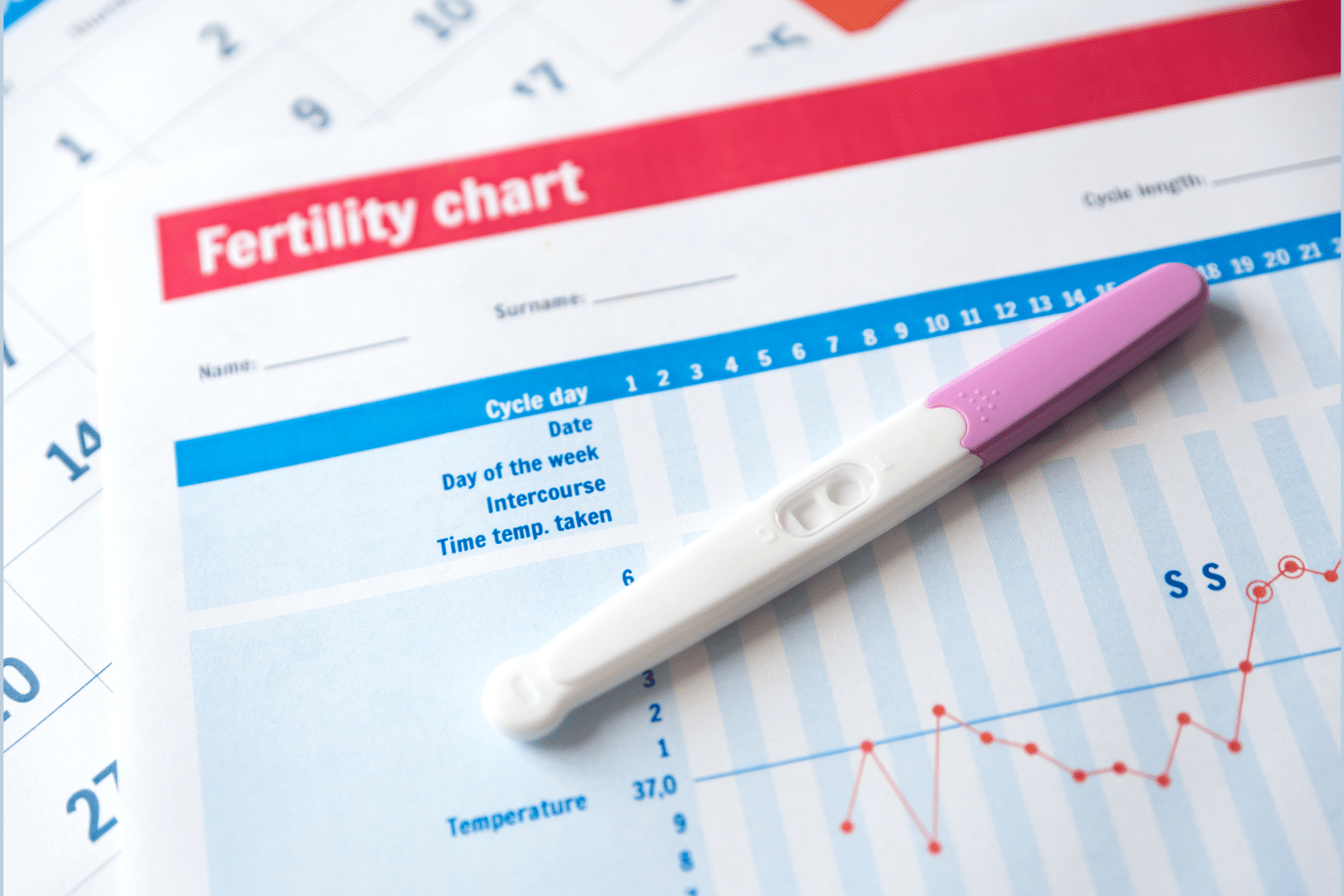
When you start trying for a baby, you need to start with the basics: when can you get pregnant? Because you’re not fertile during your whole menstrual cycle, it’s actually quite precise. Let’s dig into when your fertile window is.
What’s Your Fertile Window
The fertile window is when you can get pregnant. It means there is a mature egg that has been released by one of your ovaries during ovulation. It took three months to get to maturation, the follicle – its habitat – has ruptured, and the egg is now wandering down the fallopian tube. If it meets with sperm that is proactive and mobile (not always the case), there is fertilisation. If not, it will be absorbed by the body.
That window lasts for about 24h: from the moment the egg is released in one of your fallopian tubes, until fertilisation, if it happens.
However, sperm can live up to five days inside the womb so it can fertilise an egg several days after the intercourse. That’s why we say that your fertile window lasts for 5 days.
You can have intercourse for up to five days before your ovulation and still get pregnant. It’s also important to know if you’re trying to not get pregnant !

Identifying this timeframe is key in the process of getting pregnant. And it can change from one month to the other, as your cycles can be irregular, or at least not regulated like clockwork (like most women on no hormonal treatment). Some days it will happen on day 14, other times it can be on day 21. There shouldn’t be too much variation though, and if your cycles are too irregular, you might want to get it checked by a doctor.
Know Your Cycle to Identify When You Can Get Pregnant
Each body is a beautiful machine and the biology happening inside you each month is nothing short of a miracle. There are four distinct phases operating each cycle. If you want to explore how they affect your mood and energy levels, read Understand Your Cycle, and Dramatically Improve Your Life.
But if we focus on the “events”, knowing what’s happening is empowering to understand who does what. When trying to conceive, let’s look at three main phases : the one with oestrogen rising, leading to the ovulation phase, and the one with progesterone. The last one is your period, when all hormones are low.
Oestrogen is the first hormone we want to look into, during the first part of the menstrual cycle. There are multiple forms of oestrogen, and we’re going to look at one in particular, the one promoting ovulation. The others forms are interesting during pregnancy or menopause, so not the topics of today. Oestrogen in general has a lot of essential functions in the body like your cardiovascular health and your bone structure.
The one we want here is the oestrogen rising from the end of your period to ovulation. It helps build your uterus lining – or potential future baby’s home. The embryo / baby will get its nutrients from there. It’s women’s reason for this cyclical nature: to get ready for pregnancy, and oestrogen is running this part of the show.
Oestrogen also impacts the cervical mucus quantity and properties you see around ovulation. It facilitates the journey of the sperm inside the uterus, by being thin and elastic. The mucus can also block the sperm when it’s not ovulation time by being super thick and dense.
The LH hormone is then released when oestrogen is at its peak and the follicle ruptures. The mature egg is ejected: ovulation happens. More details on how and when to track it below.

Once ovulation has occurred, progesterone is released by the follicle that ejected its egg. Progesterone is the hormone that will promote a pregnancy. It helps the body turn the switch into protection mode, cosy vibes and not wanting to see anybody. We’re potentially creating life over here.
If conception didn’t happen, the follicle realises that it’s working for nothing, releasing progesterone, so it will stop. Once that occurs, pregnancy mode stops, hormones drop, and your period arrives.
This hormone is essential when trying to get pregnant because if there is an imbalance and you don’t create enough, a pregnancy cannot prosper.
Last hormone I want to mention, is the betaHCG. It is released when a pregnancy starts, and that is what is measured when you pee on a pregnancy test, or do a blood test for pregnancy. The amount of betaHCG you have in your blood will give you positive (or negative) pregnancy test; and give an estimate about how far along you are, in weeks, if doing a blood test.
How to Track Your Fertile Window
There are a few methods to identify when is ovulation and when it’s not.
The first one is your body temperature. When oestrogen is on the rise, your body temperature is relatively low, between 35.9 *C and 36.4*C. It’s rather constant. When progesterone starts being released, the basal body temperature increases. It will remain high until your period comes when it drops, or stay high if you’re pregnant. It can increase by an average of 0.3*C in this luteal phase.
This is the metrics I’ve been using for years, taking my temperature every single day before I get up. You need to be mindful that if you’re ill or hungover, your body temperature will increase as well and can trick you into thinking you have ovulated. It takes some time to get used to doing that, and now there are tools that you can use so it doesn’t require much effort from you, like an Oura ring.

Your cervical mucus is another important tracker. We get vaginal discharge pretty much all throughout our cycle, it’s your natural barrier to outside elements. But your cervical mucus is the barrier, or the greeting, to sperm basically. When you are fertile, it is very loose and thin, and comes out like an egg white. When you’re no longer fertile, it will be dense and thick, and sperm cannot go through. Learning how to recognise the different phases of your cervical mucus is a great indicator of your fertility. Best moment to notice it is in your panties or before / after peeing.
There are also strips that you can pee on, measuring the presence of the LH hormone. This hormone is released when oestrogen is at its peak and the egg is coming. It’s said to usually occur early in the morning, like 6.30am. Another good indicator that ovulation is occurring. When you start tracking your cycle, you can get these for cheap and when you’re supposed to ovulate, you can check. But they’re so time-bound that it’s difficult to get a positive one so don’t fret if you don’t want to obsess over it too much.
If you are comfortable with this, you can also familiarise yourself with the position of your cervix as it changes during your cycle. During ovulation, it gets quite low to facilitate the sperm’s journey to the egg. Once ovulation has occurred, the cervix goes back “up”. The change in position is subtle but with practice, you can feel the difference at different times of your cycle.
This is All to Tell You WHEN to Try to Conceive
All of these trackers, or indicators, are essential to know about when you’re trying to get pregnant. Learning about your cycle is really empowering because it helps you understand what happens in your body, why you feel or see different things at certain times in the month.
However, these are only helping to tell you when you are fertile. It doesn’t tell you if your body is ready or not to keep a fertilised egg alive and make it thrive. I’m going to share more on that in other posts so don’t go too far 🙂
The Road to Motherhood can be a Bitc*
7 Things that Saved my Postpartum
